Introduction
Sri Aurobindo reflects on the intellectual and spiritual heritage of India, emphasizing the continued relevance of Sanskrit as a language of knowledge and scholarship. The Vedic seers (Ṛṣis) explored not merely the physical world but the inner dimensions of consciousness. They sought to understand existence, mortality, and transcendence through deep inquiry. Despite historical disruptions, India’s cultural and intellectual continuity has remained resilient, preserving its philosophical and scientific traditions.
1. Use of Average (Madhyama)
Ancient Indian mathematicians emphasised the use of averaging multiple observations to obtain accurate results.
Translation: Measurements of length, breadth, and depth should be taken at multiple locations. The sum of these measurements divided by the number of observations gives the average value.
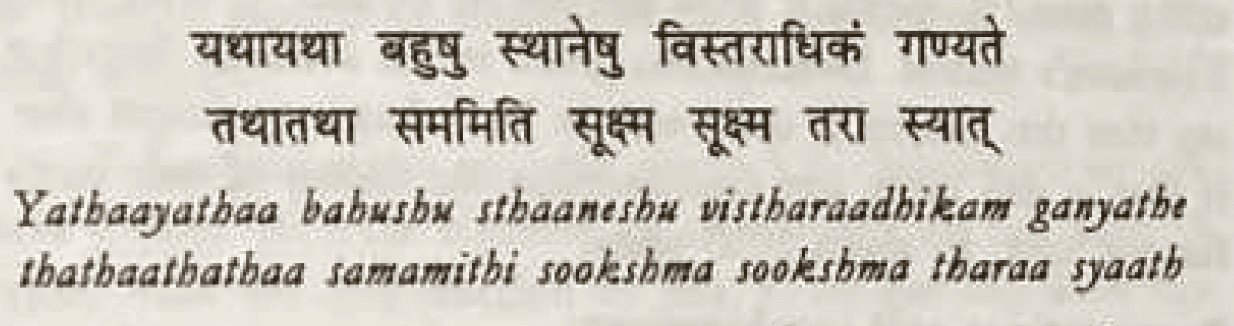
Ganesa the commentator gives the merits of determining average value of data as follows: Whenever the measurements are taken at more and more places, then more and more accuracy for values will be obtained. Brahmagupta has used the method of finding out the average of the surface area for accurately calculating the volume of the cylindrical structures.
2. Ratio and Proportion (Anupāta)
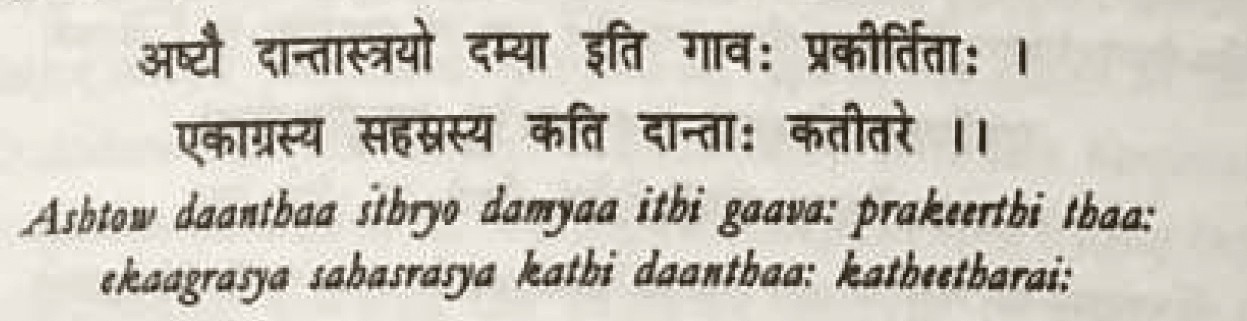
Ratio and proportion were widely used in ancient Indian mathematics to express relationships between quantities. This is an important criterion for understanding relative quality/ quantity with respect to other parameters. When we say one out of every three persons knows Sanskrit, it gives a ratio of 1:3. This type of mathematical presentation is thought to be the contribution of modern mathematics.
Explanation taken from Bhaskaracharya’s commentary for Aryabhateeya (2.26 (5)) is given below: (Out of 11 cattle) Eight are tamed and three are to be tamed and (how many are) to be tamed if the number of cows is 1001? Here the ratio between the tamed and untamed is 8:3. From this, the number of cattle tamed can be calculated by taking the product of 1001 and 8 and dividing by 11. The same is applicable for determining the number of untamed animals. Out of 11 cattle, 8 are tamed and 3 are not.
If the total number is 1001, then: Tamed = (1001 × 8) / 11 Untamed = (1001 × 3) / 11 Calculations using ratio/proportion were known to Indians at least from Bhaskara’s period. Descriptions given in the available literature say that this subject is dealt with in Bhakshali manuscripts also. If that is also taken into consideration, the history of ratio starts further back, to about 2000 years.
3. Permutations and Combinations (Vinyāsa & Saṅkhyā)
When a variety of parameters of variables are available for making the maximum number of combinations, it can be possible in different ways. Number of ways possible under a particular combination can be calculated using the principles of permutations and combinations. In modern mathematics permutations and combinations play a very useful role to get benefits of space, time, and energy savings in scientific and social activities. This has also contributed to aesthetic beauty and savings in space.
Rules and detailed scientific explanations for permutation and combination methods and their principles are seen in Jaina text Bhasvati sutra written during 300 BC. In the text, writing numbers with different combinations of the same set of digit was discussed. Ancient Indian texts describe combinatorial principles in both mathematical and applied contexts.
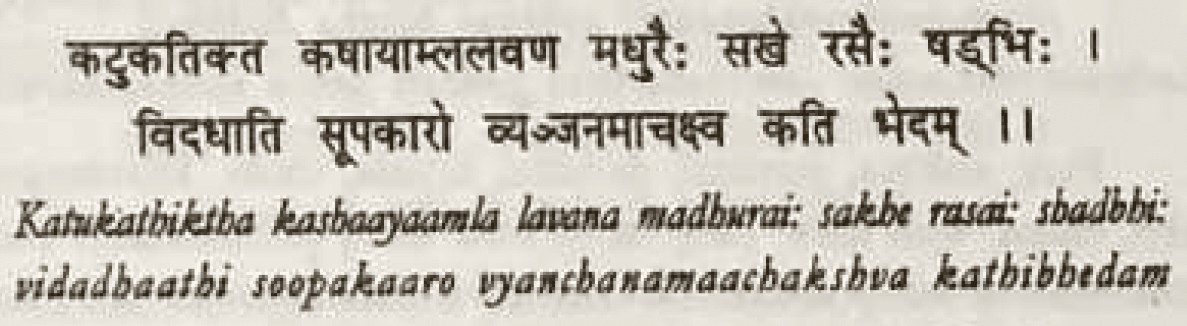
In Susrutha samhita (6th century BC), 63 possible combinations are explained from a mixture of 6 rasas (flavours) by distributing the rasas in the order of one, two, three and so on. Sreenivasa Iyengar describes this problem in detail. Sreedharacharya in Patiganita (rule 72) gives an example similar to that given in Susruta Samhita: Friend, a cook prepared varieties of food with 6 savours: pungent, bitter, astringent, acid, saline and sweet. Say what is the possible number of varieties of food that can be made with these savours. The combinations are: with one each of the savour, we can have 6 types.
With the combination of any two, we can have 15 types, with the combination of any 3, we get 20, with the combination of any 4, 5, and 6, respectively, we get 15, 6 and 1 types. These are the combinations possible. (The same is the answer for problem given on Sustrutha samhita) Translation: From combinations of six tastes, numerous variations arise. Combinatorial results: 1 at a time: 6 2 at a time: 15 3 at a time: 20 4 at a time: 15 5 at a time: 6 6 at a time: 1 Permutation and combination given in above method is, exchanging, one or more from the total set.
Another type of possible combinations is substituting the one for other in the total combination without keeping anyone/thing away from the list. Bhaskaracharya II gives an interesting mathematical problem of this type for explaining the permutation and combination possibilities, in Lilavati.
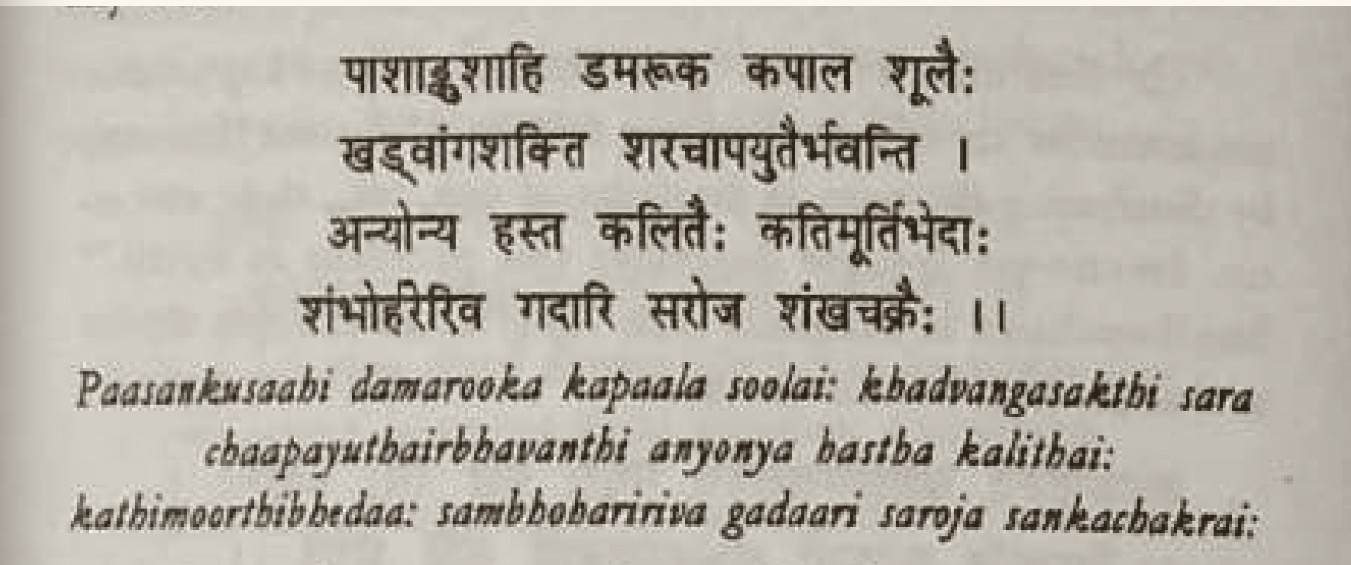
Lord Siva and Lord Vishnu with various Bhooshanas were compared in different forms when each one of the bhooshanas is substituted by other, without keeping away any one. Pasa, ankusa, serpent, damaru, kapala, soola, khatvanga, sakti, sara, chapa, with these (ten) items how many permutations and combinations are possible for Lord Siva.
Similarly with the four items, sanku, chakra, gadha and padma holding in the hands, how many combinations are possible for Lord Vishnu? It is known for mathematicians that answers for the problems are For 10 elements: 10! = 1x2x3x4x5x6x7x8x9x10 (i.e., 10! Read as factorial 10) combinations are possible for Lord Siva and For 4 elements: 4! =1x2x3x4 (i.e., 4! Read as factorial 4) combinations are possible for Lord Vishnu. Thus two types of permutations and combinations were also brought into application in India.
4. Percentage Concept (Śatamānam)
The concept of percentage, or values expressed per hundred, was known in ancient India, thousands of years ago as 'Śatamānam'. It was used in financial, commercial, and mathematical contexts. In modern mathematics many commercial and financial transactions are referred to with respect to a base number of 100. Hence it is known as per cent. The equivalent word in Sanskrit is Śatamānam. This was a subject not only from the mathematical texts, but also referred to in the Dharma shastras and Puranas.
5. Interest calculation:
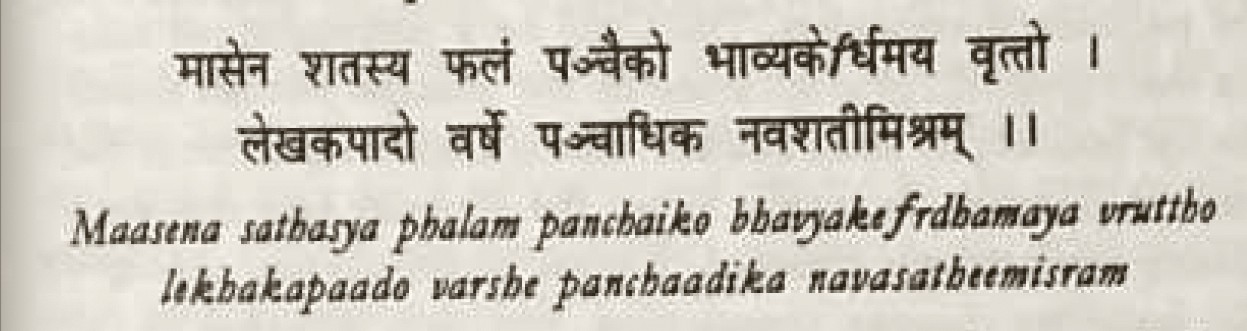
Description and application of interest are also given under the subtitle of loan. Here the subject is brought only for explaining the use of percentage in olden days. A problem from Siddhanta sekhara quoted in Patiganita (rule 48): The rate of interest being 5% per month, the commision of surety 1% per month, fee for accountant 1/2% and charges of the scribe 1/4% per month, certain sum amounts to 905 a year. Find the capital, the interest and the shares of the surety? It can be seen that the use of % was very handy for describing different financial parameters.
Another important information that can be elucidated from the above problem is, the systematic and modern approach that existed in India even in financial transactions, i.e the concept of surety, accounting charges/ fee, scribing charges, etc, being separately levied in the financial business as in modern times.

One among the many quotations, from Dharma sastra will throw light on, how the financial transactions fall in the rules of those texts. Vishnu smruti gives this quotation. The dharmik rate of interest in 1.25% per month (for common transactions connected with the household loans) for commercial purposes it can be unto 5% per month.
Courtesy: Dr. N. Gopalakrishnan, Indian Institute of Scientific Heritage